
From Institutional Research to Classroom Conversation
The Resonant Echoes platform connects institutional scholarship to the classroom. Scholars craft Echoes. Educators discover them. Students engage through conversation, debate, and Socratic seminar.
How It Works
From institutional research to classroom engagement.
Craft
Museums, libraries, and archives transform their collections and scholarly expertise into historically accurate Echoes.
Publish
The Echo enters the Lending Library with educator scaffold materials: a primer, question starters, and reflection guide.
Discover
Educators browse by subject, grade level, and format. They borrow an Echo and its scaffolding for their classroom.
Engage
Students converse 1-on-1, debate in Assemblies, or explore through Socratic seminar. History answers back.
How Scholars Craft an Echo
From research to conversation: a streamlined process designed for scholars and institutional professionals.
Define the Persona
Give your Echo a name, personality, historical context, and voice. Define who they are, when they lived, and what they know.
Upload Research
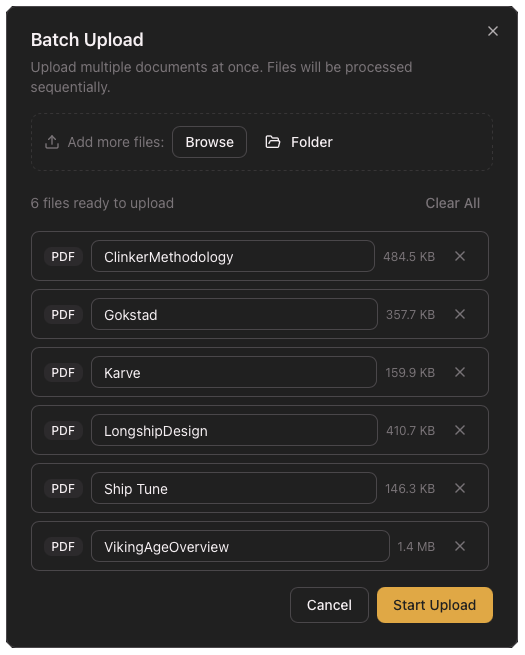
Add primary sources, scholarly articles, collection records, and any documents that should inform the Echo's knowledge base.
Upload Research
Add primary sources, scholarly articles, collection records, and any documents that should inform the Echo's knowledge base.
Add FAQ Entries
Write question-answer pairs for key topics you want the Echo to handle well. These supplement the knowledge base with expert-approved responses.
Set Guardrails
Define moderation rules for topics the Echo should avoid or handle carefully. Ensure accuracy and appropriateness for your audience.
Set Guardrails
Define moderation rules for topics the Echo should avoid or handle carefully. Ensure accuracy and appropriateness for your audience.
Review & Refine
Test conversations, review daily insights, and refine the Echo over time based on how visitors and students engage with it.
Grounded in Your Research
Every Echo draws from the documents and sources you provide. Upload text, PDFs, images, audio, and video. The platform indexes everything and uses it to ground the Echo's responses in real research.
Text & PDFs
Scholarly articles, catalog entries, field notes
Primary Sources
Letters, diaries, official records
Collection Records
Provenance, condition reports, metadata
FAQ Entries
Expert-authored Q&A pairs





Connects to What You Already Use
Resonant Echoes is building integrations with standard museum collection management systems and databases. Bring in records from your existing tools without re-entering data.
- Collection management system connectors (CMS integrations)
- API access for custom integrations
- Bulk import and structured data support
Stay Informed, Stay in Control
The platform keeps experts informed with daily insights and gives them complete control over what Echoes can and cannot say.
Insights
See what visitors and students are asking, which topics spark the most conversation, and where the Echo might need refinement. Institutions that publish to the Lending Library also see the classroom impact their Echoes are having.
- Most common questions from visitors and students
- Moderation events and flagged topics
- Knowledge base accuracy metrics
- Classroom deployments and engagement
Moderation Rules
Define content guardrails that ensure your Echo stays accurate, respectful, and appropriate for your audience. Set rules for topics the Echo should avoid, handle carefully, or redirect.
- Topic-level content guardrails
- Factual accuracy enforcement
- Sensitive topic handling rules
- Age-appropriate content calibration
Your Echoes Go Where Your Audience Is
Once an Echo is ready, it can reach students and visitors through multiple channels. The Lending Library is the primary path to classrooms.
Lending Library
Publish Echoes for educators to discover, borrow, and deploy in their classrooms.
In-Gallery
QR codes and mobile access for on-site visitor engagement in exhibits.
Web Embed
Embed Echoes on your website for remote access and virtual tours.
Traveling Shows
Partner institutions can borrow Echoes for traveling exhibitions.
The Lending Library
The Lending Library is a searchable catalog where educators discover historically accurate voices for their classrooms. Browse by subject, grade level, historical period, or format.
Every Echo in the Lending Library includes educator materials: a before-conversation primer, suggested question starters, and a post-conversation reflection guide. Your prep time is already done.
Join the Educator PilotBrowse & Filter
Find Echoes by subject area, grade level, historical period, and pedagogical format.
Educator Materials
Each Echo ships with scaffold materials: primer, question starters, and reflection guide.
Classroom Ready
Borrow an Echo and deploy it with your class. No configuration required.
Institution Backed
Every Echo is attributed to the institution that created it. Institution-grade scholarship.
Structured Debate
Two Echoes in opposition. Opening statements, cross-examination, closing arguments. Timer-based.
Socratic Seminar
Multiple Echoes in free-flowing discussion. The most relevant voice chimes in organically as the conversation unfolds.
Panel Discussion
Two or more Echoes answer in sequence, each from their own perspective on the same event.
Assemblies: The Past, Willing to Debate
What if your students could challenge explorers from different centuries to compare navigation techniques, or pit a Renaissance engineer against an Industrial-era inventor in a debate over what it means to innovate? That's an Assembly. Two or more Echoes, shaped by scholars and curators, inhabiting the same structured format. A formal debate. A Socratic roundtable. A panel discussion.
Each Assembly format maps to evidence-backed learning science. Structured debate changes student positions 31 to 58% of the time. Peer dialogue produces learning gains equivalent to roughly two years of growth. Socratic questioning systematically exposes contradictions and deepens reasoning.
Ready to Give History a Voice?
Whether you build Echoes or teach with them, let's talk about how Resonant Echoes can work for you.
Join the Pilot